
Recent Arrests in Greenville County are posted daily on the official portal, giving the public immediate access to the newest booking reports and today’s detention log. Visitors can view the daily inmate list, recent jail entries, and current arrest records at 4 McGee Street, Greenville, SC 29601, or call (864) 271‑5210 during office hours, Mon‑Fri 8:30 AM‑5:00 PM. The site also features the latest detainee roster, recent mugshots archive, and daily arrest summary for quick reference.
Understanding how to locate the latest police bookings, current police detentions, and recent criminal charges helps families and researchers stay informed. The online search portal (https://gcso.org/) displays the latest police custody list, recent booking snapshots, and current jail booking details, while also noting bond information and charge classifications. Users can track recent law enforcement arrests, see the recent suspect list, and review the latest detainee information without navigating complex databases.
How to Search Recent Arrests
Recent Arrests in Greenville County can be checked through the Greenville County Sheriff’s Office online search portal. The records can help you locate the newest booking reports, daily inmate list, recent jail entries, and today’s detention log. You can also explore inmate population through available county records. Each result may show dates, alleged charges, bond details, and custody status. Treat every result as a jail record, not proof that a person committed an offense.
Official Search Portal: https://gcso.org/
Steps to Search
- Open the Greenville County Sheriff’s Office website and locate the inmate, jail, or arrest-record lookup in the main navigation.
- Open the current inmate or recent-booking view. A current roster shows people held now, while a recent-booking view helps you review the newest daily inmate list and latest police bookings.
- Enter the person’s surname first. Add a first name or other available field only when needed, since broad searches can produce fewer mistaken exclusions.
- Run the search before adding narrow date or status filters. A booking date outside the selected period can hide an otherwise current match.
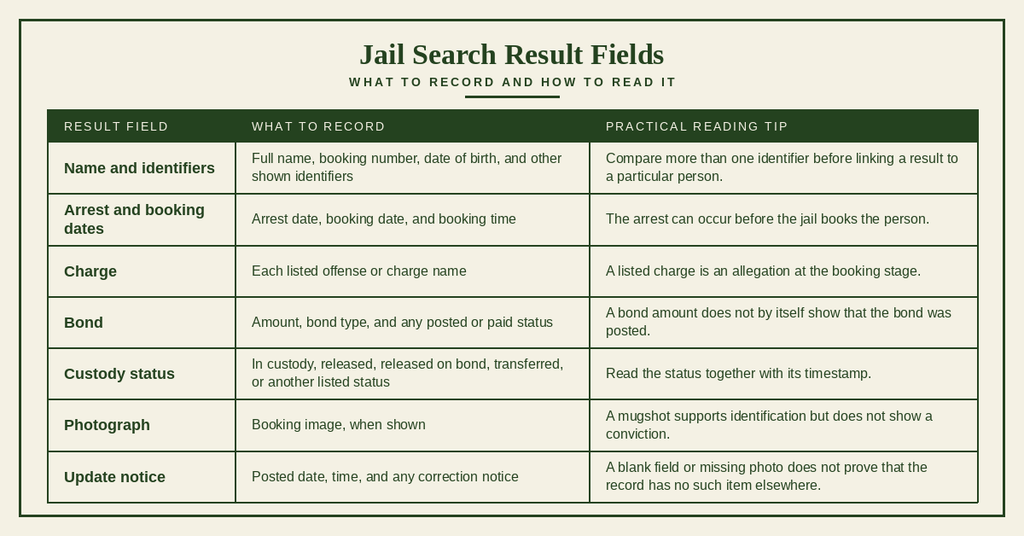
- Open each matching entry and record its booking number, booking date and time, alleged charge, bond amount, custody status, and update time when shown.
- Compare the booking date with the arrest date. A jail may receive a person before the online entry appears, and the two dates may differ.
- Check the status and update time before drawing a conclusion about current custody. A photo or older booking record can remain visible after a release or transfer.
- Save the exact name, date, and booking number from any result you need to cite. These details make a correction request or follow-up inquiry more precise.
What Counts as a Recent Arrest
The word “recent” has no single fixed legal meaning in a jail roster. It can refer to a person booked today, an entry added during the latest daily posting cycle, or a person whose custody status changed recently. The date attached to the result and the portal’s update time provide the clearest context.
Newly Reported Arrests
A newly reported arrest enters the public roster only after law enforcement and jail staff complete the required reporting steps. The arrest itself may happen hours before the person arrives at the jail, and the online entry may appear later. For that reason, the booking date and posting time can differ from the time of the actual arrest.
Recent Booking Entries
A recent booking entry normally gives the clearest match between a law enforcement arrest and a jail record. It may include the booking date, booking time, alleged charge, bond amount, photograph, and custody status. A booking entry confirms that the jail processed an intake record; it does not confirm that every listed charge was proved in court.
Current and Recently Released Individuals
The latest detainee roster can show current inmates and, depending on the portal view, people released recently. The custody label controls the meaning of the row. A name with a booking photograph can remain visible as part of a booking history even after the person leaves the jail.
Time Limits for Recent Arrest Listings
Do not assign a fixed seven-day, 30-day, or other look-back period unless the portal states that period for the selected view. The searchable list can move forward as new bookings arrive, and archived records may sit outside the main roster. Record the date and time of your search so a later result can be compared with the version you saw.
Charges Listed After an Arrest
Charge fields in a recent booking record help identify the alleged legal basis for custody. They can change as the case moves through court, so the booking entry should be read as a dated snapshot rather than a final case record. The Greenville County court docket provides the later procedural history and any final disposition.
Offense Name
The offense name is the short label used by the booking system for the alleged crime. It may use a legal code, a common name, or wording supplied by the arresting agency. News reports can use a different term for the same event, so search with the portal wording after checking the date, location, and booking details.
Charge Description
A charge description gives a short account of the alleged conduct tied to the arrest. It may not include the full legal elements, the complete court record, or later amendments. Readers should compare the description with the official case record before drawing conclusions about what happened.
Charge Classification
Charge classifications commonly separate alleged felonies from misdemeanors and may include other listed categories. The booking label reflects the charge at that stage, and the court can amend or dismiss a charge after a hearing. A classification also does not state the final punishment because that decision belongs to the court.
Multiple Charges
One booking can contain more than one alleged charge. Each row may represent a separate count rather than a separate arrest. Read every charge and its description instead of using the first label as a summary of the whole matter or treating the number of counts as proof of multiple crimes.
Bond Information
Bond fields may show an amount, the type of bond, or whether the bond has been posted or paid. A figure listed beside a charge does not confirm that the person has left custody. Bond payment, recognizance, and release are separate events, and the booking row may not show every condition attached to a release.
Recent Arrest Processing
An arrest moves through several stages before the public record reaches its final status. Each stage creates a different piece of the case history. Knowing the stage helps explain why an arrest date, booking time, charge, bond, and custody label may not match one another exactly.
Initial Arrest
An arrest can occur with a warrant, after police observe probable cause, or during another lawful police action. The person may then be transported to the jail for booking. The arresting agency and the agency maintaining the jail listing can differ, so the agency named in a news report may not match the name shown in the roster.
Booking
Booking creates the jail’s intake record and usually assigns a booking number with a date and time. The record can include the person’s name, photograph, alleged charge, bond entry, and initial custody status. This event is the central reference point for the newest booking reports and current jail booking details.
Identification and Intake
During intake, staff collect and compare identifiers so the jail can create the correct person record. A middle name, suffix, date of birth, or spelling may differ from what the public uses. Users can also reference county auditor for additional information. For that reason, a booking number and booking time can prevent a false match when two people share a name.
Bond Determination
Initial bond is generally set through a legal process after an arrest, and the booking system may display the resulting amount. The amount is not set by the appearance of a booking photo or a news report. Questions about a specific bond, payment receipt, or release condition belong with the court or agency named on the record.
Release or Continued Custody
A person may remain in custody, leave on bond or recognizance, or receive another release decision after the first court appearance. A later hearing can also produce continued detention or a change in bond. The custody label records the most recent posted result, so an early snapshot may no longer describe the person’s current location.
Transfer to Another Facility
A transfer moves custody to another jail or agency. The original booking row may remain in the Greenville County listing with a transferred status, or it may point to a receiving record. Check the status date and agency name before assuming that the person remains at the location shown in the booking history.
Current Status of Recent Arrests
Custody status answers a narrow question: where the jail record places the person at the latest posted update. It does not answer whether the arrest was valid, whether every charge was proved, or whether a court case has ended. The status and its timestamp should always be read together.
In Custody
An in-custody label means the person was held by the listed jail at the latest update. It does not reveal the expected release date, the next hearing date, or the bond decision that may come later. Use the booking number when asking about the same person across different daily lists.
Released
A released status means the person was no longer held at that jail as of the posted update. The arrest and court case may still exist after release. A released booking can remain visible as part of the recent-booking history, so its presence does not prove current detention.
Released on Bond
Released on bond identifies a specific release from custody, not the outcome of the criminal case. The portal may not show the conditions, surety, payment receipt, or later compliance record. A person released on bond can still face court dates and further custody actions.
Transferred
A transferred status means custody moved to another facility or agency. The booking may stay visible because it documents the original jail intake, yet the person may no longer be at 4 McGee Street. For current location, follow the receiving agency or the transfer details attached to the entry.
Status Changes
Custody can change after the booking row first appears. A release, transfer, new charge, or correction may produce a newer status without creating a second arrest. Compare the update time with the original booking time so that two snapshots of the same case are not mistaken for two separate bookings.
Recent Arrest Data Updates
The latest arrest database can change as agencies add, correct, or remove rows. A daily arrest summary, daily booking sheet, or recent booking snapshot reflects the posted data at that moment. Use the update label and check the portal again when a case has a time-sensitive event.
Newly Added Entries
Newly added entries usually carry a recent posting or intake date. If a row appears after you opened the page, refresh or reopen the search before reaching a conclusion. A rolling daily inmate list may replace earlier rows, so the posting time matters more than the order in which results appear.
Delayed Arrest Listings
Reporting delays can begin with the arrest, transport, intake, identification, or portal posting. No fixed waiting period applies to every case. People searching for the newest booking reports should compare the last posted time with the known arrest time and revisit the portal before treating a missing row as a failed search.
Updated Charge Information
An updated charge can reflect an amended count, a dismissed count, or a newly added allegation. The row may retain the original booking time even when the charge changes later. For recent police record updates, compare both dates so the booking event stays connected to the later legal action.
Updated Custody Status
An updated custody status often follows a bond hearing, release decision, transfer, or court order. The portal may show the change within the same row instead of creating a fresh entry. A status change does not erase the arrest, so a released person can still appear in a recent-booking view.
Corrected Entries
Corrections may fix spelling, identifiers, dates, charge wording, or another data-entry issue. The corrected row can look similar to the earlier version, with a posted update time showing the change. You can also access white pages to review official records. Anyone relying on a specific field should preserve the current version and report a clear discrepancy to the sheriff’s office.
Removed or Archived Entries
A removed row may have moved out of the active daily list or into an archive. Its absence does not show that the arrest never occurred. Historical questions may require a records request or a different search view, especially when the needed event falls beyond the current roster’s rolling period.
Limits on Recent Arrest Records
The jail roster and the court docket have different jobs. A jail roster records intake and custody, while a court docket tracks charges, hearings, rulings, and disposition. Recent arrest records can answer operational questions, yet they cannot replace the full case file.
Arrest Does Not Establish Guilt
An arrest records police custody, not a conviction. A person listed after arrest is presumed innocent unless and until the court proves the charges under applicable law. A booking photograph, bond amount, and charge description offer context about the arrest, but none of those fields establishes guilt.
Preliminary Charge Details
Charge wording in a booking entry is preliminary because the court can change it during the case. A later filing may add, amend, or dismiss an allegation. For the current legal claims against a person, consult the court docket tied to the case rather than treating the jail’s first charge label as final.
Reporting Delays
Reporting delays can affect arrests, bookings, charges, and status changes at different points. A missing row may reflect a pending entry rather than a missing event. A delayed status may also leave an old label on screen until the next update, so recent law enforcement arrests should be checked against the portal’s posted time.
Incomplete Entries
Some booking rows have blank fields because staff have not entered a value, the data is unavailable, or the public view does not display it. A missing photo, bond line, or identifier should not be treated as proof that the person lacks a photograph, owes no bond, or has no other record. Check related official case sources.
Changes After Initial Booking
Many facts can change after the first booking entry appears. The charge list, bond, release status, and custody location may all change as the case advances. Use the most recent update time when describing the person’s status and label the earlier booking date when discussing the initial intake.
Restricted Details
Some records may be limited by law, privacy rules, sealed matters, age-related protections, or active investigations. A recent mugshots archive can show a booking image without exposing every protected detail connected to the case. Do not attempt to infer hidden facts from a missing field, an image, or an unlisted charge.
Search Problems
Most search issues come from timing, spelling, record scope, agency naming, or a status that has changed. Work through one factor at a time, and keep the booking date and identifier from each close match. This prevents a broad name search from turning into a mistaken identification.
Arrest Not Yet Listed
An arrest may not appear because the person has not reached booking, the intake record is still being processed, or the online posting has not occurred. No promised number of minutes or hours applies to every case. Check the portal’s latest posted time and revisit it later before making a formal inquiry with the office.
Name Search Returns No Results
Try the surname with and without a first name, then test common spelling variants and check for a middle initial. Remove narrow date
Frequently Asked Questions
Find quick answers about locating recent arrests, booking details, and related information for Greenville County.
How can I view recent arrests in Greenville County?
Visit the Greenville County Sheriff’s Office online search portal at https://gcso.org/. Enter the name or case number of the person you are looking for. The system returns the newest booking reports, daily inmate list, and recent jail entries. Each result shows the arrest date, alleged charges, bond amount, and custody status. The portal updates throughout the day, so you can check the latest information during office hours, Monday through Friday, 8:30 AM to 5:00 PM.
Where do I find the latest police bookings online?
Log into the official search portal provided by the Greenville County Sheriff’s Office. After selecting “Recent Arrests,” the site displays current police detentions and the latest detainee roster. Results include the newest booking reports and daily booking sheet. You can filter by date to see today’s detention log or view a broader range of recent police record updates. No registration fee is required, and the data reflects the most current police custody list.
What info appears in today’s detention log?
Today’s detention log lists each individual booked on the current date. For each entry you will see the name, booking time, alleged criminal charges, bond details, and whether the person remains in custody or has been released. The log also indicates the location of detention, such as the county jail, and provides a link to any available recent mugshots archive. This snapshot helps the public understand the latest inmate intake for the day.
How are recent mugshots accessed by the public?
Mugshots are posted alongside the arrest record on the Sheriff’s online portal. After locating a name in the recent arrest summary, click the link labeled “Mugshot” to view the image. The gallery updates as new bookings are entered, offering a recent mugshots archive. If a photo does not appear, it may be withheld for privacy or ongoing investigation reasons. The portal does not require a login to view publicly released images.
Who to contact for errors in the arrest database?
If you notice inaccurate data, call the Greenville County Sheriff’s Office at (864) 271‑5210 during business hours. Explain the discrepancy, providing the person’s name and case number if possible. Staff will verify the information and correct any mistakes in the current arrest records. You may also submit a written request through the contact form on the official website, referencing the specific entry that needs updating.